Messenger Chat Home
- 4.3
- Rating
- 1.00M
- Installs
- Free
- Price

 Analysis by App-foxy
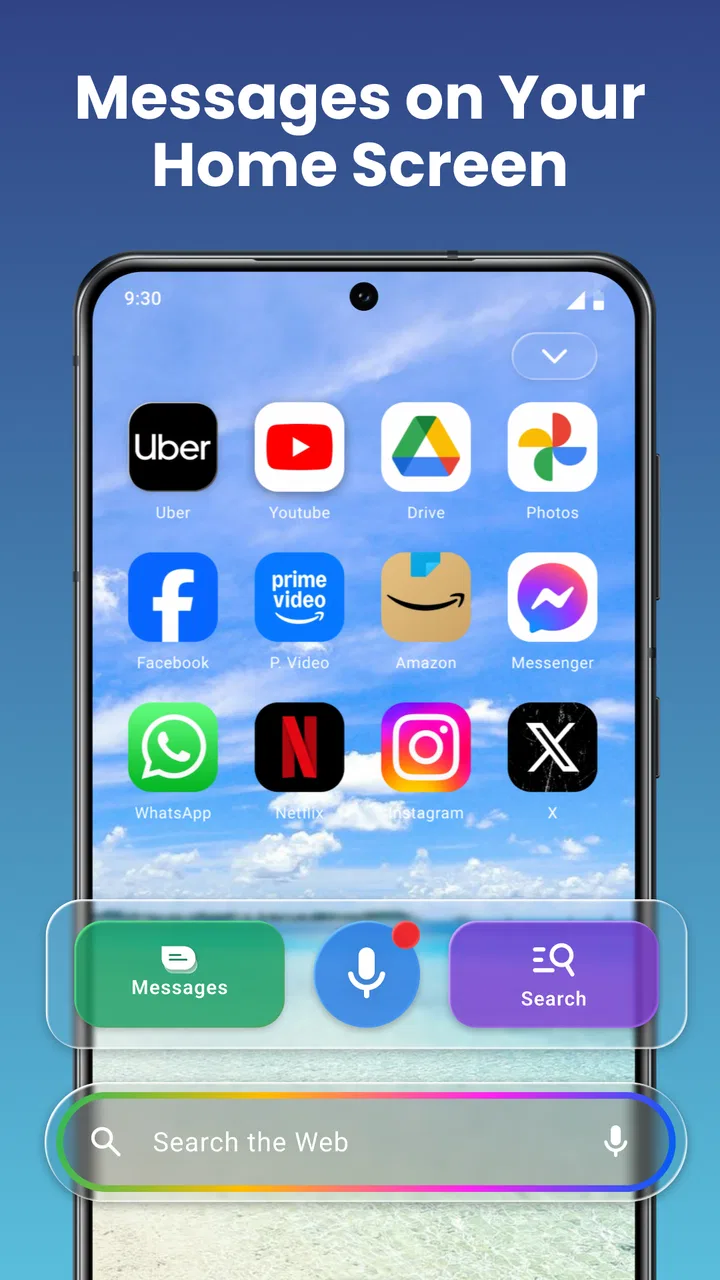
I noticed Messenger Chat Home for a very specific reason: it puts SMS and group conversations close to the place where I already begin many tasks, the Android home screen. That sounds like a small change, but it can alter the rhythm of replying. Instead of opening a traditional messaging app, finding a thread, and then returning to whatever I was doing, I can use the launcher as the starting point for a quick conversation. The idea is simple, but its value depends heavily on whether you want speed and convenience more than a full-featured messaging environment.
This is a free personalization app from Avalon Solutions LLC, rated for Everyone. It is available for Android devices running version 10 or later, and the current version is 1.01.35. The app has reached over 500 thousand installs, with a 4.5 average from around 7.7 thousand ratings. Those figures suggest that the home-screen messaging concept has found a real audience, although I would still judge it by how well it fits my daily routine rather than by popularity alone.
Why home-screen messaging feels different
The central capability is not simply sending a text. It is the combination of SMS, group chat, GIFs, and emojis directly from the launcher. In practice, that makes the home screen feel less like a static collection of icons and more like a communication surface. I can treat a conversation as something immediately available rather than something hidden behind several taps.
You May Also Like

 Blood Strike: 2.5 Anniversary
Blood Strike’s Loadouts Turn Every Drop Into a Tactical Gamble
A close look at Blood Strike’s custom loadouts: how fast access to signature weapons reshapes its battle royale rhythm, rewards preparation, and narrows the gap between fights.

 Pandora - Music & Podcasts
Pandora’s Music Is Easy to Start, but Harder to Recover
Pandora’s strength is its low-effort path from a seed to a station. Its weak spot is how much confidence it asks you to place in connection, setup, and quiet recovery.

 8 Ball Pool
 Is Built on Rivalries, Rematches, and Routine
A close look at the rivalries, rematches, shared routines, and unanswered safety questions that turn a quick pool match into a persistent mobile community.

 Samsung Music
’s Quiet Strength Is Playing What You Already Own
Its reach comes less from spectacle than from dependable access to a personal library. That simplicity is both the app’s strongest retention engine and its ceiling.

 AccuWeather: Weather Radar
AccuWeather Review: A Quick, Clear Forecast for Everyday Decisions
For everyday plans, the best forecast is the one you can understand quickly. AccuWeather makes rain timing, radar, and local conditions easy to act on, with a few trade-offs.

 Hill Climb Racing
Why Hill Climb Racing Still Turns Crashes Into One More Run
A tiny car, a bumpy hill and one more upgrade: Hill Climb Racing keeps resurfacing because its simple chaos makes every near-miss feel personal.
More From Our News Desk



That distinction matters most for short exchanges. If someone asks whether I am on my way, needs a quick confirmation, or sends a message that only needs a brief reaction, the launcher-based approach can feel more natural than opening a conventional messenger. The app is designed around reducing the distance between seeing the phone and responding to a conversation.
I also like that the capability is not limited to plain text. GIFs and emojis are part of the appeal because they make a short reply more expressive without requiring a long explanation. A quick emoji can confirm that I saw something, while a GIF can add tone when a written response might sound too blunt. That is especially useful in casual group chats, where speed and personality often matter more than formal organization.
Still, I would not describe this as a replacement for every messaging tool. Its strongest identity is as a fast, launcher-centered way to handle everyday conversations. People who need extensive conversation management, deep media organization, or a broad social platform may find a conventional messaging app more comfortable. The benefit here comes from immediacy, not from trying to become an all-purpose communication suite.
What the launcher changes in an ordinary day
With a standard messaging workflow, I usually unlock the phone, open the messaging app, wait for the conversation list, choose a thread, and then write. None of those steps is difficult, but they create enough friction that I may postpone a small reply. Messenger Chat Home brings the conversation closer to the first screen I see, so a response can become part of the same action as checking the time or looking for another app.
This is a useful distinction for people who communicate in small bursts. I can imagine using it while leaving home, checking a message from a family member, or answering a group question while moving between tasks. The app does not make the message itself more important; it makes the decision to respond easier because the conversation is not as far away.
The home-screen placement can also help when I am trying to keep a simple routine. Rather than opening a social feed and becoming distracted, I can go straight to a practical conversation. That makes the app more focused than platforms where messaging is mixed with news, public posts, video, and recommendations. For someone who wants communication without a larger social environment, that focus is a genuine advantage.
Using GIFs and emojis without overthinking a reply
The visual side of the app works best when I treat it as a shortcut for tone. A group message can be difficult to answer with only “okay,” because the word may sound cold or impatient. Adding an emoji gives the reply a little context. In a more playful conversation, a GIF can communicate amusement or surprise faster than several sentences.
There is a practical trade-off here. Visual replies are quick, but they are not always clear. Emojis can mean different things to different people, and a GIF may be funny to one group while confusing another. I would use these tools freely with friends and familiar groups, but I would choose plain wording for anything important, sensitive, or easy to misunderstand.
One useful habit is to decide what the message needs before opening the visual options. If the goal is confirmation, a short text may be clearer. If the goal is warmth or humor, an emoji or GIF can save time. That small decision prevents the launcher from turning every reply into a search for the perfect reaction.
A realistic group-chat routine
My favorite use case is a group coordinating a simple plan. Imagine a family chat deciding who will pick up dinner. One person asks for confirmation, another changes the timing, and someone else sends a joke about being late. From the home screen, I can follow the exchange, answer the practical question, and use a quick reaction to acknowledge the joke without opening a larger social app.
This scenario shows why the app is more than a decorative launcher feature. The home screen becomes a place where a conversation can be completed in small steps. I do not need to compose a long message every time I check the thread. I can answer the part that matters, use a visual response when appropriate, and move on.
It is also a good fit for people who often receive messages while doing something else. If I am preparing food, packing a bag, or switching between errands, a short launcher-based interaction can be easier than navigating through a full messaging interface. The advantage is not that it removes all taps; it is that it keeps the communication task close to the surface.
Where the experience can become less convenient
The same simplicity that makes the app appealing may feel limiting to heavy messengers. If I am searching through a long history, managing many conversations, or handling a complicated media exchange, I may prefer the standard messaging application. A launcher is a good starting point for quick contact, but it is not automatically the best environment for detailed conversation management.
Another consideration is attention. Putting messages on the home screen can make communication more visible, but that visibility may also encourage frequent checking. Someone who is trying to reduce interruptions might prefer messages to stay inside a separate app. The feature is helpful when I want faster access; it is less helpful when I want stronger separation between communication and the rest of the phone.
Group chats can expose another trade-off. Quick access makes it easier to keep up, but group conversations can move quickly and become noisy. If I only need occasional updates, a conventional notification system may feel calmer. Messenger Chat Home is better suited to people who actively want the conversation nearby rather than those who prefer to check messages at set times.
I would also be careful about choosing visual replies automatically. GIFs and emojis are convenient, but they can make a serious message feel too casual. The app gives me faster expressive tools, not better judgment. I still need to consider the recipient, the subject, and whether a visual response could be misread.
How it compares with ordinary messaging choices
Compared with a standard SMS app, the most noticeable difference is the starting point. A traditional messenger is organized around its own inbox, while this app emphasizes the launcher. If I already spend most of my time inside the default messaging application and do not mind opening it, the change may not justify adjusting my routine.
Compared with social messaging platforms, the appeal is narrower and more direct. I am not being asked to enter a broader feed or community before reaching a conversation. That can make the experience feel cleaner for basic personal and group communication. On the other hand, people whose friends and family all use a particular social platform may find that platform more useful because it already contains their contacts and established habits.
The app makes the most sense when the problem is access rather than a lack of messaging options. I do not need another place to chat simply because it is available. I need it if the home screen is genuinely the most convenient place for me to begin a conversation. That is the key comparison point: convenience of entry, not a promise of replacing every existing messenger.
Small workflow choices that improve the experience
I found three practical ways to get more value from the concept. First, I would keep the launcher focused on conversations that actually need quick attention. If every possible thread is treated as urgent, the home screen becomes cluttered and the original advantage disappears. The app works best when it helps me reach active communication, not when it tries to represent my entire message history at once.
Second, I would use visual replies as deliberate signals. A reaction is useful when the other person already understands my tone, while a short sentence is safer when the conversation involves plans, timing, or responsibility. This makes GIFs and emojis a support for communication rather than a substitute for clarity.
Third, I would separate quick replies from conversations that deserve a slower response. The launcher is ideal for confirming, acknowledging, or adding a small comment. If a group discussion becomes complicated, I would move into the more traditional messaging workflow and give it my full attention. That two-level approach preserves the app’s speed without forcing every conversation into a compact interface.
These choices also answer a question many people have before installing it: does putting messaging on the home screen automatically make messaging better? Not always. It makes a certain kind of messaging faster. The improvement is strongest when my messages are short, frequent, and connected to tasks I am already doing.
Who will benefit most from the app
I would recommend it to people who rely on SMS and group chats throughout the day and dislike the repeated process of opening a separate app for every small reply. It is particularly attractive for users who enjoy expressive responses but do not want to enter a full social network to find GIFs and emojis. Families, friend groups, and busy users coordinating everyday plans are likely to notice the benefit first.
It may also suit someone who wants a more communication-focused home screen. Instead of treating the launcher only as a grid of app icons, this approach gives conversations a more visible role. That can be useful for people who frequently need to answer messages while moving between work, errands, and home activities.
I would be more cautious about recommending it to someone who wants minimal distractions, prefers a very traditional Android layout, or spends most of the day in a single established messenger. It is also not my first choice for someone who needs a highly organized archive, advanced conversation tools, or a communication environment built around a specific online community. In those cases, the usual messaging app or social platform may remain the better fit.
What the current release tells me
The app was released on April 3, 2024, and Avalon Solutions LLC continues to present it as a focused personalization tool rather than a general social network. Its current version, 1.01.35, reflects an app that is still relatively focused in identity: the main reason to install it is the home-screen messaging workflow, not a long list of unrelated functions.
That focus is important when setting expectations. I would install it because I want faster access to SMS and group conversations, GIFs, and emojis from the launcher. I would not install it expecting the home screen alone to solve every messaging problem. The app’s success depends on whether its central capability fits naturally into the way I already use my phone.
After spending time with the concept, my opinion is positive but specific. Messenger Chat Home is most valuable when a few seconds of saved navigation can make the difference between replying now and postponing the message. It turns the launcher into a communication shortcut, and that can feel surprisingly useful during busy, ordinary moments.
For me, the best reason to recommend it is not novelty. It is the way the app supports small, real conversations: confirming a plan, reacting to a group joke, sending a quick emoji, or answering a family member without disappearing into a larger app. If that is how you communicate, the free price and Everyone rating make it easy to try. If you prefer a quiet home screen or need deep messaging management, I would stay with the conventional alternative. This app earns its place when the launcher is where you want your conversations to begin.
FAQs for Messenger Chat Home
01What is Messenger Chat Home and how does it work?
Messenger Chat Home is a comprehensive messaging app designed to streamline communication. It integrates text, voice, and video chat, allowing users to connect seamlessly with friends and family. The app features a user-friendly interface with customizable chat themes, emojis, and stickers to enhance your messaging experience.
02Is Messenger Chat Home free to use?
Yes, Messenger Chat Home is free to download and use. However, it offers in-app purchases for premium features and additional customization options. These can include special stickers, advanced themes, or ad-free experiences, enabling users to tailor the app to their preferences.
03What platforms is Messenger Chat Home available on?
Messenger Chat Home is available on both Android and iOS platforms. It is compatible with most modern smartphones and tablets, ensuring that users can access its features regardless of their device. Regular updates are released to maintain compatibility with the latest operating systems.
04How does Messenger Chat Home ensure user privacy and security?
Messenger Chat Home prioritizes user privacy and security by implementing end-to-end encryption for all messages. This ensures that only the sender and recipient can read the messages. The app also includes security features such as two-factor authentication and customizable privacy settings.
05Can I use Messenger Chat Home for group chats and video calls?
Yes, Messenger Chat Home supports group chats and video calls, making it ideal for both personal and professional communication. Users can create group chats with up to 200 participants and enjoy high-quality video calls with up to 10 people simultaneously, ensuring connectivity with larger groups.
Pros
- Intuitive user interface with quick access.
- Seamless integration with social networks.
- Customizable chat themes and backgrounds.
- Low data consumption during usage.
- Supports voice and video calls efficiently.
Cons
- Limited offline functionality.
- Occasional notification delays.
- Requires frequent updates for stability.
- Ads may interrupt user experience.
- High battery consumption on prolonged use.

Messenger Chat Home
Gallery